SHRM CP Situational Questions Provide Clear Strategies to Choose the Best Answer
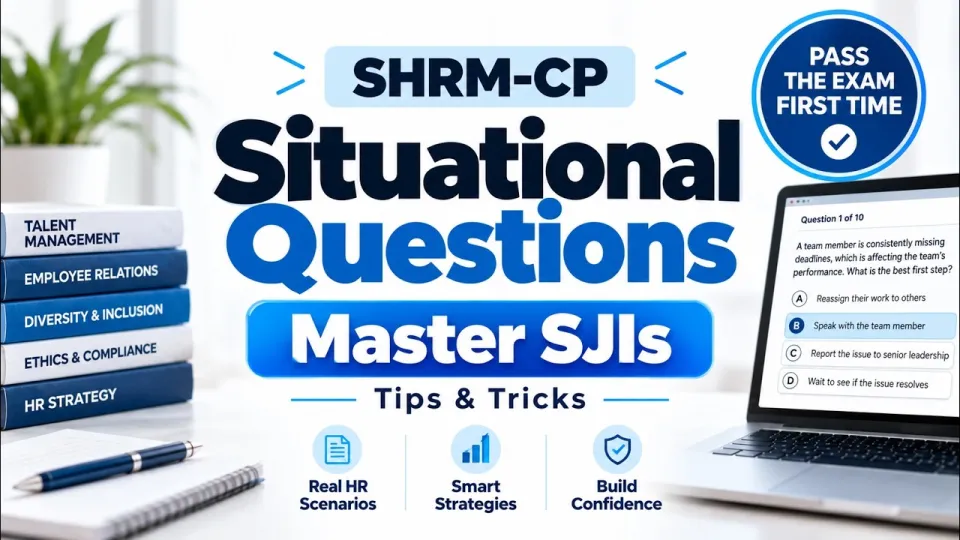
Video: SHRM CP Situational Questions (SJIs) | TIPS TO PICK THE RIGHT ANSWER
· based on the channel PrepSolution
Key takeaways
- SHRM CP situational questions focus on realistic HR scenarios requiring judgment.
- Five decision checks guide the best answer: facts, policy, escalation, HR’s role, involvement.
- Common answer traps include premature action and unnecessary escalation.
- Distinguish between first step vs. most effective solution in responses.
- PrepSolution offers free SHRM CP practice questions and detailed explanations.
Situational Judgment Questions (SJIs) in the SHRM Certified Professional (CP) exam test your ability to apply HR knowledge to real workplace dilemmas. These questions often present multiple plausible responses, making it challenging to select the best answer. Understanding how to analyze these questions systematically is crucial for success.
Understanding SHRM CP Situational Questions
SHRM CP situational questions simulate real HR problems requiring ethical, legal, and practical judgment. They assess your capability to balance organizational policies, employee relations, and compliance. Each question usually presents a scenario followed by four answer options, all of which may seem reasonable at first glance. The goal is to select the option that best aligns with SHRM’s standards and HR best practices.
Five Decision Checks to Identify the Best Answer
When evaluating situational judgment questions, applying the following five decision checks will help determine the most appropriate choice:
- Facts: Analyze the scenario details carefully without assuming information not provided.
- Policy and Law: Ensure the action complies with relevant company policies and legal requirements.
- Appropriate Escalation: Recognize when to involve higher management or other departments without over-escalating.
- HR’s Role: Understand HR’s supportive and advisory role rather than taking over managerial responsibilities.
- People Involved: Consider all stakeholders affected by the decision, including employees and supervisors.
Distinguishing Between First Step and Most Effective Response
A critical strategy is to identify whether the question asks for the first action to take or the most effective overall solution. Some questions focus on immediate next steps in a process, while others expect a final resolution that best addresses the issue. Misinterpreting this can lead to selecting a premature or incomplete answer.
Common Answer Traps to Avoid
PrepSolution highlights five key traps that test-takers frequently fall into:
- Premature Action: Choosing a response that acts too early without gathering enough information.
- Passive Responses: Selecting an option that avoids taking necessary action.
- Taking Over Manager’s Responsibilities: Overstepping HR’s advisory role by managing direct disciplinary actions.
- Unnecessary Escalation: Escalating issues that can be resolved at a lower level.
- Legally Defective Options: Choosing answers that could violate employment law or company policy.
Testing each answer against these traps using the scenario’s facts and wording helps eliminate incorrect choices.
Applying Practical Elimination Techniques
Instead of relying solely on personal workplace experience, compare each answer option directly with the scenario’s facts and the question’s wording. Eliminate choices that conflict with legal or policy considerations or that do not appropriately involve the right parties. This disciplined approach improves accuracy in selecting the answer that aligns with SHRM standards.
Practice Scenario Example
Consider a situation where a supervisor wants an employee disciplined after a shouting match. The question asks how HR should respond. Using the five decision checks:
- Is immediate discipline warranted, or is fact-finding needed first?
- Does HR’s role include conducting the discipline or advising the supervisor?
- Should the issue be escalated to higher management?
Evaluating each answer option against these criteria reveals the best course—typically gathering facts and advising proper management steps before any discipline.
Useful Resources for SHRM CP Exam Preparation
PrepSolution provides extensive free practice questions and detailed explanations to master situational judgment questions. Access these at PrepSolution SHRM CP Free Practice.
Useful links
Conclusion
SHRM CP situational questions require a structured approach to distinguish between plausible answers and select the most appropriate one. By applying the five decision checks, recognizing common answer traps, and understanding whether the question demands the first step or the best solution, candidates can improve their accuracy. PrepSolution’s detailed walkthroughs and free practice resources offer valuable support for mastering these questions and excelling in the SHRM CP exam.
Questions & answers
What are SHRM CP situational judgment questions?
They are scenario-based questions on the SHRM CP exam designed to assess how candidates apply HR knowledge and judgment to real workplace situations.
How do I identify the best answer in SHRM CP situational questions?
Use the five decision checks—facts, policy and law, escalation, HR’s role, and involved people—to evaluate each option and eliminate traps like premature action or unnecessary escalation.
What common traps should I avoid when answering these questions?
Avoid choosing answers that act too early, are passive, overstep HR’s role, escalate unnecessarily, or violate legal and policy guidelines.
Where can I find practice questions for SHRM CP situational judgment?
PrepSolution offers free SHRM CP situational judgment practice questions and detailed explanations at https://prepsolution.com/free-practice/shrm-cp?utm_source=youtube&utm_medium=video&utm_campaign=shrmcp_longform&utm_content=cp_long_v09.
Source: SHRM CP Situational Questions (SJIs) | TIPS TO PICK THE RIGHT ANSWER · Markdown version